
A city needs better drainage. An industrial area needs cleaner energy and more efficient water management. Workers need safer transport, while surrounding communities need protection from flooding and environmental degradation. These challenges have something in common: addressing them requires investment. Green finance can help mobilize the necessary capital, but providing funding is only part of the solution. How do we determine where investment is most needed, which priorities deserve attention, and whether the benefits will extend beyond an individual project?
Answering these questions requires us to look beyond the project itself and consider the wider environment in which it operates. This is where ESG, green finance and urban planning come together.
Three Perspectives, One Goal
Each brings a different perspective to the same challenge.
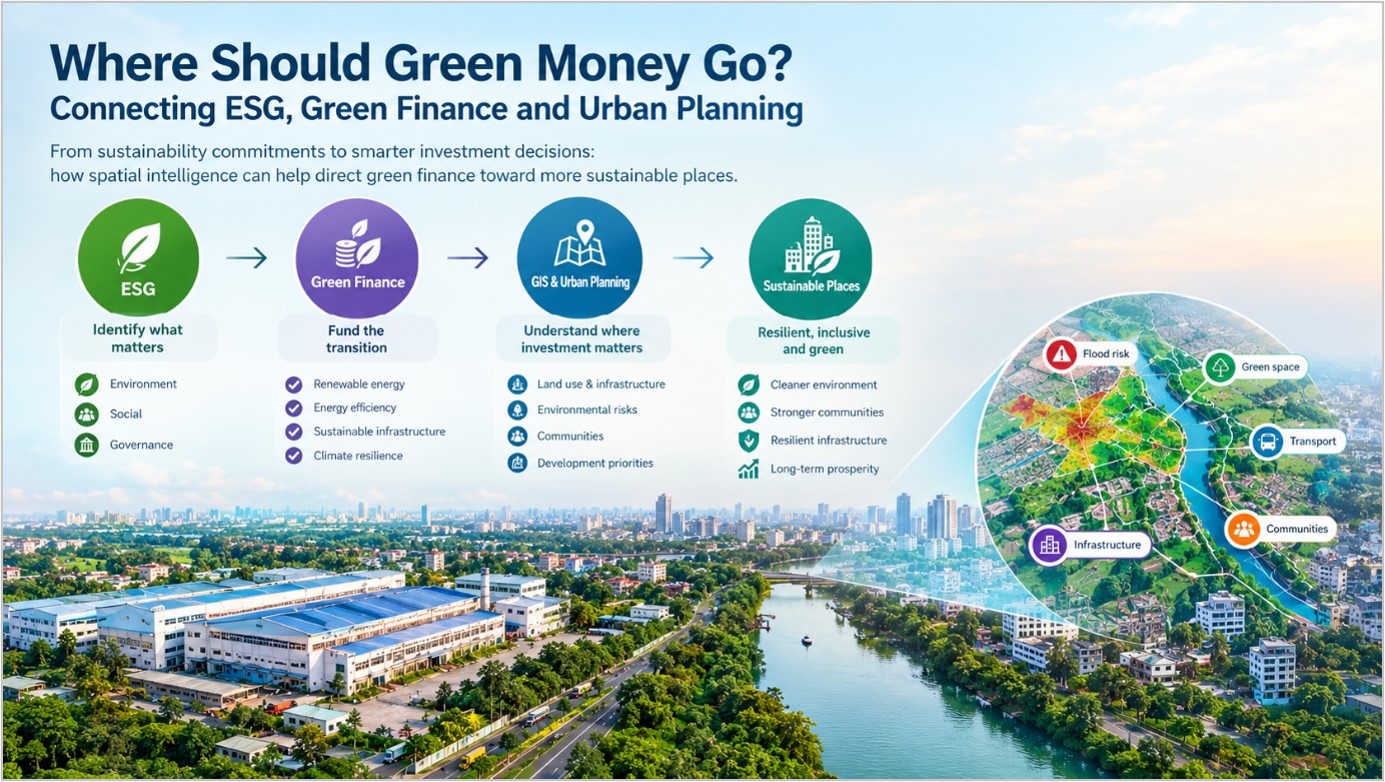
ESG helps identify what matters. It provides a framework for assessing environmental impacts, social outcomes, governance practices and sustainability-related risks.
Green finance helps fund the transition. It can support eligible activities such as renewable energy, energy efficiency, sustainable water management and climate-resilient infrastructure.
GIS and urban planning help establish where action is needed. By connecting ESG information with land use, infrastructure, environmental hazards and surrounding communities, spatial analysis can reveal risks and opportunities that may not be apparent from project-level data alone.
The value lies in bringing these perspectives together. Rather than evaluating an investment only by its individual performance, decision- makers can also consider how it interacts with the surrounding environment, infrastructure and communities.
Beyond the Green Factory: A Bangladesh Example
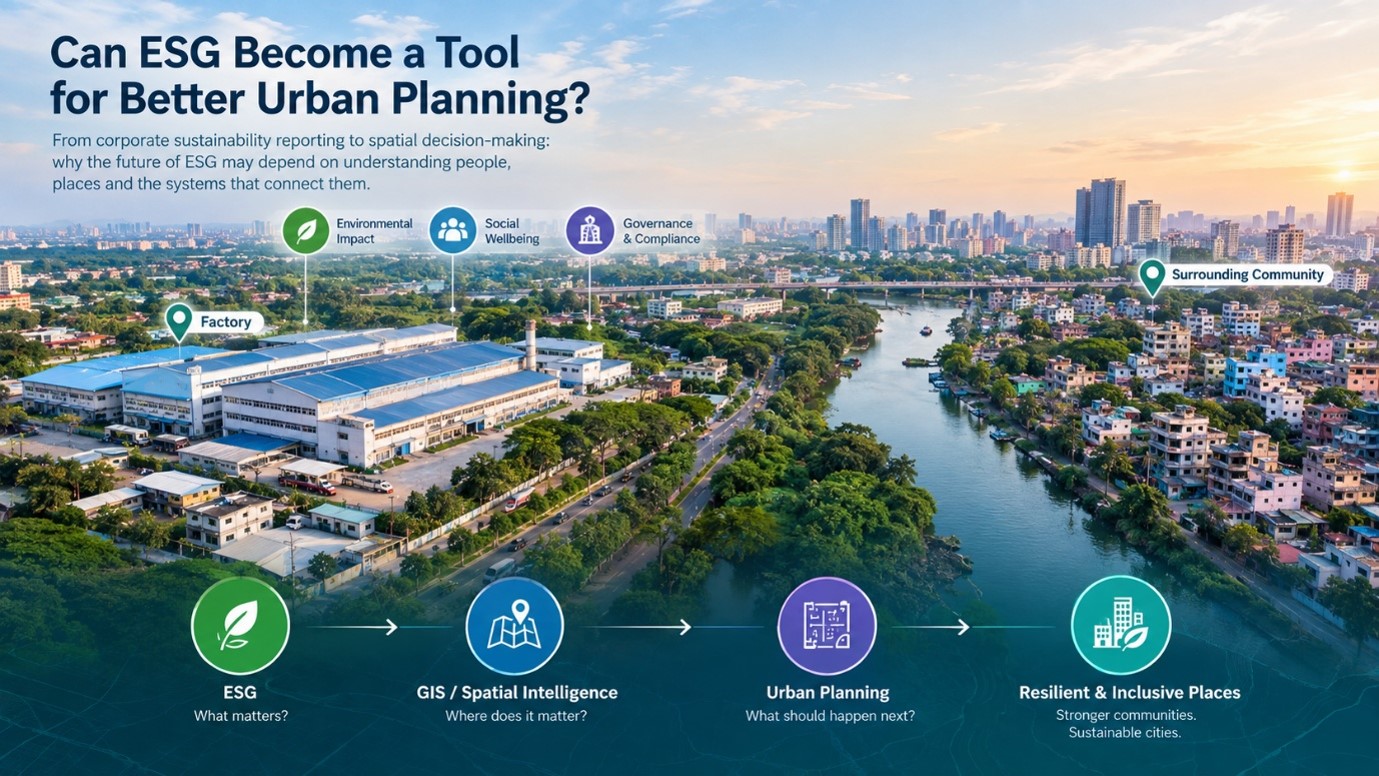
Consider a garment factory in an industrial area of Bangladesh seeking finance to improve energy efficiency, conserve water and manage waste more responsibly. These are worthwhile improvements. Yet a closer look at the surrounding area might reveal a different set of challenges: nearby worker settlements experience waterlogging, drainage capacity is inadequate, public transport is limited, and water bodies are under pressure from urban expansion. The factory can improve its own environmental performance, but many of the risks affecting its operations and workers originate beyond its premises.
What if investment decisions considered both the factory's sustainability performance and the conditions of the industrial area around it?
GIS-based analysis could help identify where drainage improvements are most needed, which routes workers depend on, and which water bodies are important for environmental protection and flood management. Urban planning could then help translate these findings into coordinated development priorities. Depending on project feasibility, financing eligibility and stakeholder responsibilities, some interventions might be addressed through individual investments, while others would require coordination among businesses, financial institutions and public authorities.
The point is not that every factory should finance the surrounding area. It is that understanding the wider context can reveal opportunities to make individual investments more effective and support broader sustainability goals.
From Sustainability Data to Better Decisions
This is where spatial intelligence becomes particularly valuable. ESG assessments can identify significant risks and sustainability priorities, but location-based analysis helps explain where those risks occur, who may be affected and what infrastructure or environmental systems influence them.
When combined with urban planning, this information can help decision- makers compare potential interventions, identify investment priorities and establish indicators for monitoring results. Such analysis does not replace financial appraisal or green-finance eligibility requirements. Instead, it provides an additional evidence base for evaluating how proposed investments relate to local needs and longer-term development objectives.
Financing Sustainable Places
For Bangladesh, where industrial growth, urban expansion, infrastructure needs and climate vulnerability often intersect, connecting investment decisions with spatial planning can offer a broader perspective on sustainability. The challenge is not simply to mobilize more green capital. It is to understand what that capital can achieve, who stands to benefit, which risks remain, and how investments contribute to the places where people live and work.
Achieving this requires collaboration among financial institutions, businesses, planners, environmental specialists, GIS professionals and public authorities. Green finance cannot solve every urban challenge, and spatial analysis alone cannot determine which projects should receive funding. But together, these disciplines can help make investment decisions more informed, coordinated and responsive to real-world needs.
So, where should green money go?
ESG identifies what matters.
GIS reveals where it matters.
Urban planning helps determine what needs to change.
Green finance helps fund eligible solutions.
When these perspectives work together, sustainability becomes more than a commitment made by an individual organization. It has become part of a wider effort to create resilient infrastructure, protect environmental resources and improve the places where communities live and work.
The goal is not simply to finance greener projects, but to make green investment contribute to more sustainable places.
Share this page via
More from Asma Amin Rimi